*(for EU passport holders)
When we arrived to Spain we had to deal straight away with the famous and scary bureaucracy. What we actually found out is that it is not scary at all (at least for what concerns buying a car) unless you mess all the procedure by yourself. Blaming the bureaucracy is always quite a simple act, but what is not obvious is: trying not to mess with it.
So, two weeks after our arrival we found a car that was suitable for our needs. Good price, apparently all in order. The seller was a Northern European guy, he had an apartment in Andalucía (Malaga) and looked like a person who knew what we had to do. So, in a couple of days we went to see the car, tried it, bought it…but wait. Not everything went so smoothly.
NIE AND GESTOR
We went to buy the car and, at the last moment I was told that I needed my NIE. Now, I have a very old NIE, and as many people know, this identification number does not expire. So, I asked my NIE to the police explaining that I needed it for buying a car, the policeman was so nice to write my number down on a torn piece of paper (after checking all my personal information using my passport) and we went to Malaga to get our car.
The seller took us to a “gestor” as we all were foreigners and the best move, in his opinion, was to rely on some local expertiese. We accepted this suggestion as it sounded quite consistent. A gestoría is that place where all the bureaucracy knots disappear after a certain compensation. In this case, the first gestor gave a quick look at our papers and said that my NIE could not be accepted because it was written on a piece of paper. I asked the gestor employee to verify the number together with my passport. No. The only answer I got was NO.
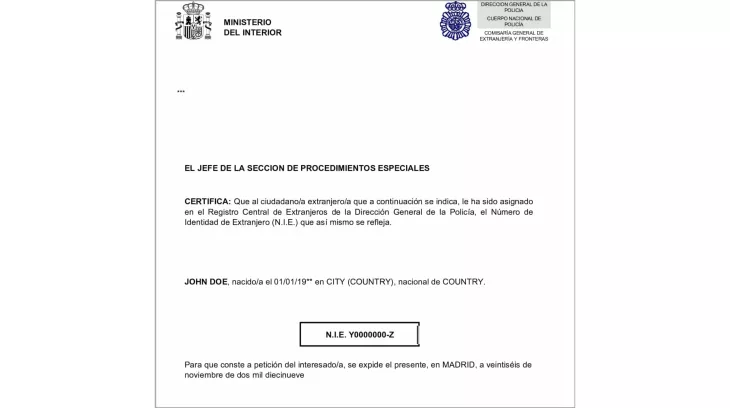
The paper required had to show clearly that it was released by the Guardia Civil. It had to be a standard format that cannot be confused with anything else. Now, my question was (and still is) what makes this document some kind of unique when it is printed on a normal sheet of paper, and can be photocopied. Why we cannot use the number as it is and that number cannot be just dialed and entered in a database? This is anyway how the NIE copy looks like:
Today, the NIE card seems to look like this instead:
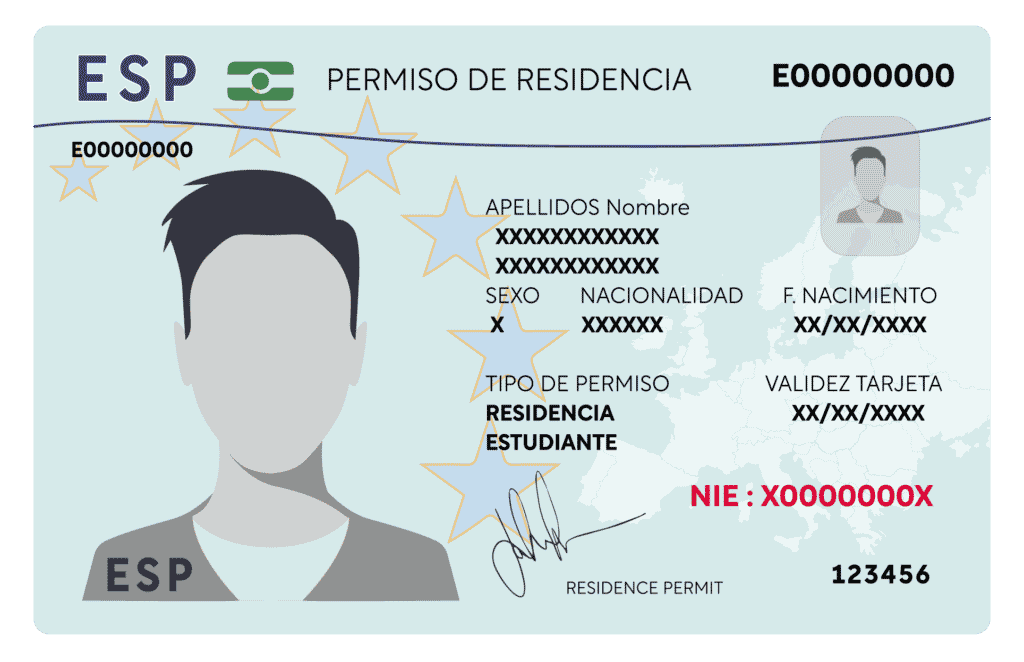
If you want to get more info about how to get NIE, you can cklick this link where I found the procedure well explained.
We went to ask the police again (Guardia Civil) if it was possible to get the official document that reported the number. The Guardia Civil officers were very nice and friendly and said that they couldn’t give me that paper and (IMPORTANTLY) they couldn’t understand why I needed that official piece of paper if gestorías have access to the official information about people who have a NIE.
TWO-HUNDRED-SEVENTY-EUROS. ONLY!
We did not manage anyway to get to buy the car, and we decided to ask google for another gestor. It was getting late, all the offices were going to close, and the seller suggested to go to the closest to us. In the end, why not trusting him? He knew the place since 20 years before.
We found this very friendly and smiley gestor, one who accepted all our documents and my thorn piece of paper with the NIE on it, saying that: ” There is no problem! I’ll do a couple of phone calls, check how to do it and, at latest in 2 days you’ll get all your documents. I take care of everything for the modest amount of 270 € plus all the costs of the transfer documents”
Even today I have a shiver that runs down my spine when I think of the lightness with which J., the seller, took us from one manager to another, taking it for granted that we would pay that absurd price. And we paid it, but...
Two days later, our supergestor called saying that nothing could be done as my NIE was missing… Again that sheet of paper was messing us. So, the smiley turned into a slimy gestor, telling me that he wouldn’t refund us unless we went in person to his office. We paid cash and he could only give us cash.
I will save the details of a ridiculous discussion with a person who wanted to avoid a transaction that his bank would have found suspicious. Suspicious and I had no right to ask him the money on a my bank account as the policy of his company was that: you give cash, I give you cash. And after all, he claimed, it was not even a huge amount he charged! So, I said I would have asked advice to the “colegio de gestores” about this all situation.
The money came to us. Cash. The seller brought it to us with all the documents we had left at “Gestoría Trampa”, while the gestor said it was the first time in his life that he gave back money. Can you imagine?
We decided that it was time to do by ourselves. We asked some help to the local police in the village where we live and we were told what we needed to do step by step. Then we made a contract with the insurance company and also there we got further advice. Actually, between the local police and the insurance we got almost all the information and documents done. Thanks a lot to this helpful people!
I reserved some time (cita previa) at the Police station and this time I got the authentic NIE! The one I needed from the very beginning.
We had to get some documents from the DGT (Dirección General de Tráfico), but, in the end, all together it came much cheaper than the “gestor”. For all the transaction we paid around 70 €. Anyway the cost depends on several elements such as the value of the car you buy.
If you are an EU passport holder looking to buy a second-hand car in Spain, you’ll need the following documents:
1. Proof of Identity:
- Valid Passport or EU National Identity Card: This confirms your identity as an EU citizen.
- Foreign Identification Number (NIE – Número de Identificación de Extranjeros):– The NIE is essential for any official or financial transactions in Spain. You can apply for an NIE at a local police station or through the Spanish consulate in your home country.-
2. Proof of Address in Spain:
- Certificate of Empadronamiento (Padrón): This document proves your residence in a particular municipality in Spain. You can obtain it from the local town hall (Ayuntamiento).
3. Vehicle Transfer Documents:
- Sales Contract (Contrato de Compraventa): This document is signed between the buyer and the seller, detailing the transaction.
- Vehicle’s Technical Inspection Certificate (ITV) and Logbook (Permiso de Circulación): These documents confirm that the car is roadworthy and registered.
- Vehicle Transfer Application Form (Solicitud de Transferencia de Vehículos): This form is submitted to the Dirección General de Tráfico (DGT) to officially transfer ownership.
- Proof of Payment of Municipal Road Tax (Impuesto de Circulación): Ensure that the seller has paid the road tax for the current year.
4. Payment of Taxes and Fees:
- Transfer Tax (Impuesto de Transmisiones Patrimoniales – ITP): This tax is typically 4-8% of the vehicle’s value, depending on the region.
- Fee for Registration Change: You’ll need to pay a fee to register the car in your name at the DGT.
Once you have these documents, you can proceed with the purchase, finalize the vehicle transfer, and register it in your name at the local traffic office (DGT). Don’t forget to find an insurance suitable for your needs. The car insurance is mandatory in EU.
Remember: save all the emails, messages about each and single bill you pay and send to anyone (included DGT).









 our journey to Spain
Leave a comment